
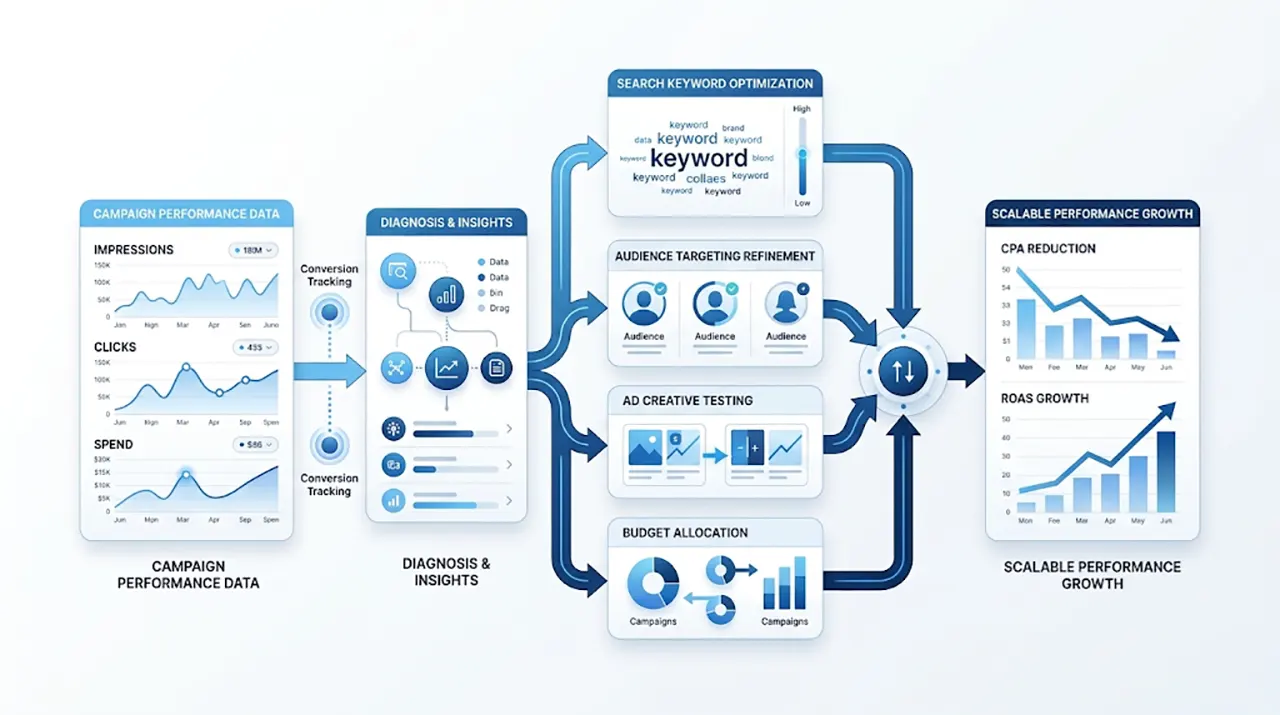
Ads optimization is the process of improving paid advertising campaigns so they generate maximum business results from the available budget. It includes improving targeting, creative, keywords, bidding, budgets, conversion tracking, landing pages, and measurement.
The goal is not simply to get more clicks. It is to generate more valuable conversions at a cost the business can afford.
A strong ads optimization process looks like this:
Business goal → accurate tracking → campaign data → diagnosis → optimization → testing → scaling
This approach works across Google Ads, Meta Ads, TikTok Ads, Amazon Ads, and other paid advertising platforms.
What is ads optimization?
Ads optimisation means continuously improving an advertising campaign based on performance data and business goals.
An advertiser may optimize:
- Target audiences
- Keywords and search terms
- Ad copy
- Images and videos
- Landing pages
- Bids
- Budgets
- Campaign structure
- Conversion goals
- Tracking and attribution
The right changes depend on what the campaign is trying to achieve.
For example, an ecommerce business may optimize for profitable conversion value and ROAS. A service business may focus on qualified leads and cost per acquisition. A brand campaign may focus more on reach, awareness, or engagement.
That is why there is no single definition of a “perfect” ad campaign.
The best campaign is the one that produces the right business result at an acceptable cost.
Why is ads optimization important?
Launching an ad campaign is only the beginning.
Performance can change as competitors adjust their bids, audiences respond differently to creative, search behavior changes, and advertising platforms receive new data.
Without ongoing optimization, you may continue spending money on campaigns, audiences, keywords, or ads that are no longer producing strong results.
Ads optimization helps you:
- Reduce wasted ad spend
- Improve conversion rates
- Lower acquisition costs
- Increase conversion value
- Improve lead quality
- Find better audiences
- Identify strong-performing ads
- Allocate budget more effectively
- Make better decisions from campaign data
The key is to optimize toward business outcomes rather than vanity metrics.
A campaign with a high click-through rate can still be unprofitable if those clicks do not produce customers.
How does ads optimization work?
A reliable optimization process starts with measurement and moves toward testing and scaling.
1. Define the business goal
Start by deciding what the campaign needs to accomplish.
Possible goals include:
- Generate qualified leads
- Increase purchases
- Reduce customer acquisition cost
- Increase revenue
- Increase conversion value
- Improve ROAS
- Increase profitable customer volume
Your goal determines what you should measure.
For example, if you want more qualified leads, CTR alone is not enough. You need to know which clicks become leads and which leads become customers.
2. Make conversion tracking reliable
You cannot optimize reliably if your conversion data is wrong.
Before changing bids or budgets, check that the account is correctly tracking the actions that matter.
Depending on the business, these may include:
- Purchases
- Lead forms
- Phone calls
- Appointment requests
- Quote requests
- Sign-ups
- Qualified leads
Google says its Smart Bidding systems use conversion data to optimize bids toward conversions or conversion value. Google also recommends having a solid foundation of conversion data before implementing a new bidding strategy. (Google Help)
For businesses using Google Ads, accurate conversion tracking is therefore part of ads optimization itself.
See ScorUp’s guide to setting up conversion tracking in Google Ads for more detail.
3. Find the biggest performance problem
Do not change everything at once.
First identify where the campaign is losing performance.
For example:
- Low impressions may point to budget, bids, targeting, or limited demand.
- High CPC may point to competition, targeting, or bidding.
- High CTR with few conversions may point to traffic quality, the offer, the landing page, or tracking.
- Good conversion volume with high CPA may point to targeting, bids, search terms, or weak conversion quality.
- Cheap leads with poor sales results may indicate a lead-quality or attribution problem.
This diagnostic approach is more useful than making random account changes.
4. Make focused changes
Once you identify the likely problem, make a change that addresses it.
Examples include:
- Removing irrelevant search terms
- Improving ad messaging
- Testing a new landing page
- Adjusting budget allocation
- Changing a bidding strategy
- Improving conversion tracking
- Testing new creative
- Refining audience signals
Avoid making many unrelated changes at the same time. If performance changes afterward, you may not know what caused the improvement or decline.
5. Measure the result
Give the campaign enough time and data to evaluate the change properly.
The correct evaluation period depends on the platform, campaign objective, conversion cycle, spend, and amount of data available.
Google explains that advertisers should consider conversion delay when evaluating Smart Bidding performance. It recommends allowing conversion cycles to pass before judging certain bidding changes. (Google Help)
6. Scale what works
Once a campaign consistently produces valuable results, look for ways to increase volume without destroying efficiency.
That can mean:
- Increasing budget
- Expanding successful targeting
- Adding proven keywords
- Creating new variations of successful creative
- Expanding profitable locations
- Testing additional campaigns
Scaling should follow the economics of the business.
Increasing spend is not automatically optimization.
What should you optimize in an ad campaign?
Targeting
Targeting determines who has the opportunity to see your ads.
Depending on the platform, this may include:
- Keywords
- Search terms
- Locations
- Demographics
- Audiences
- Interests
- Placements
- Customer lists
- Retargeting audiences
Do not assume that narrower targeting is always better.
An audience can be too broad and waste budget, but it can also be too narrow and restrict the platform’s ability to find potential customers.
The right balance depends on the campaign objective and available conversion data.
Ad creative and messaging
Your creative needs to give the right person a reason to act.
Test meaningful differences in:
- Headlines
- Offers
- Benefits
- Calls to action
- Images
- Videos
- Product demonstrations
- Social proof
- Value propositions
The goal should not be to find the ad with the highest CTR alone.
Instead, find the message that attracts people who are most likely to become valuable customers.
TikTok’s current advertising guidance, for example, emphasizes ongoing creative testing and platform-specific creative practices. (TikTok For Business)
Keywords and search terms
For search advertising, review what people actually search for.
Look for:
- High-value search terms
- Irrelevant searches
- Expensive searches with weak results
- New keyword opportunities
- Poor keyword-to-ad matches
- Terms that should be excluded
A keyword with a higher CPC can still be more valuable than a cheap keyword if it produces better customers.
Bidding
Bidding determines how aggressively the platform competes for advertising opportunities.
Google’s Smart Bidding uses machine learning and auction-time signals to optimize bids toward conversion or conversion-value goals. (Google Help)
The correct bidding approach depends on the campaign goal, available conversion data, and business economics.
Do not change bidding strategies simply because another strategy appears popular.
First ask:
- What result am I optimizing for?
- Which conversion represents that result?
- Is the conversion data accurate?
- Is there enough data to support the strategy?
- Can the business afford the target acquisition cost?
Budget
Budget optimization means putting more money into opportunities that produce valuable results while controlling inefficient spend.
Do not automatically move money toward the campaign with the most clicks.
Instead, consider:
- CPA
- Conversion rate
- Conversion value
- ROAS
- Lead quality
- Customer value
- Marginal acquisition cost
TikTok’s current Campaign Budget Optimization system, for example, is designed to distribute a campaign-level budget across ad groups to maximize conversion volume. (TikTok Ads)
Landing pages
An ad only gets the visitor to the page.
The landing page has to turn that visitor into a customer or lead.
Check whether the page:
- Matches the ad’s message
- Loads quickly
- Works well on mobile
- Clearly explains the offer
- Has a strong call to action
- Builds trust
- Removes unnecessary friction
- Tracks the intended conversion
If your ads attract qualified traffic but the landing page converts poorly, changing the ads may not solve the real problem.
Which metrics matter for ads optimisation?
There is no single best advertising metric.
The right metrics depend on the campaign’s goal.
CTR
Click-through rate shows how often people click after seeing an ad.
CTR can help evaluate relevance and creative appeal, but it does not tell you whether those clicks become customers.
CPC
Cost per click shows how much you pay for each click.
A lower CPC is not automatically better.
Cheap clicks are worthless if they never produce valuable actions.
CPM
Cost per thousand impressions helps you understand the cost of reaching an audience.
A good CPM depends on the platform, audience, industry, campaign objective, competition, and other factors.
There is no universal CPM that makes every campaign successful.
Conversion rate
Conversion rate shows how often visitors complete the desired action.
It helps identify whether the traffic and post-click experience are producing results.
CPA
Cost per acquisition shows how much advertising spend is required to generate a conversion.
For lead generation, however, you should go beyond the first conversion and measure lead quality.
ROAS
Return on ad spend compares tracked conversion value with advertising spend.
For example, spending $1,000 and generating $4,000 in tracked conversion value produces a 4x ROAS.
But ROAS is not the same as profit.
Profitability depends on margins, operating costs, customer value, and other business factors.
Lead quality
For service businesses, lead quality can be more important than lead volume.
A campaign producing 100 low-quality leads may be worse than one producing 30 qualified leads.
Useful downstream metrics include:
- Qualified lead rate
- Lead-to-customer rate
- Revenue per lead
- Customer acquisition cost
- Customer lifetime value
How do I optimize Google Ads?
Google Ads optimization involves improving the parts of a campaign that affect delivery, traffic quality, conversion performance, and business value.
Start with:
- Conversion tracking
- Conversion goals
- Campaign structure
- Keywords and search terms
- Ads and assets
- Targeting
- Bidding
- Budget
- Landing pages
- Performance measurement
Google’s current Recommendations system groups recommendations into areas such as Bidding & Budgets, Ads & assets, Keywords & Targeting, and Repairs. (Google Help)
You can use these recommendations to identify opportunities, but you should still judge each recommendation against your business goals.
What is a good Google Ads Optimization Score?
Google Ads Optimization Score ranges from 0% to 100%, with 100% meaning Google estimates that the account or campaign can perform at its full potential. (Google Help)
A high score can be useful, but it should not become your main business KPI.
A campaign with a 100% Optimization Score is not automatically more profitable than one with a lower score.
Look at:
- Conversions
- CPA
- Conversion value
- ROAS
- Lead quality
- Revenue
- Profitability
Google says Optimization Score is calculated using account statistics, settings, status, available recommendations, and recommendation history. (Google Help)
Is $20 a day good for Google Ads?
It can be, but there is no universal answer.
A $20 daily budget may generate useful data in a market with relatively low CPCs. In an expensive market, it may produce too few clicks or conversions.
Your budget should be based on factors such as:
- Average CPC
- Expected conversion rate
- Target CPA
- Search volume
- Competition
- Customer value
- Geographic market
For example, if your target CPA is $40, a $20 daily budget may make it difficult to generate consistent conversion volume.
The better question is not “Is $20 a day enough?”
It is:
“Can this budget generate enough useful traffic and conversion data to support the campaign’s goal?”
Is $500 a month enough for Google Ads?
$500 per month works out to about $16.67 per day over 30 days.
Whether that is enough depends on the campaign.
A small local business with relatively inexpensive clicks may be able to use that budget to test demand. A highly competitive national campaign with expensive clicks may need substantially more.
Before setting the budget, estimate:
Expected clicks = budget ÷ average CPC
Then:
Expected conversions = clicks × conversion rate
This gives you a basic forecast before spending the money.
How does ads optimization differ across platforms?
The basic optimization process is similar, but each platform has different signals and campaign mechanics.
| Platform | Main optimization focus |
|---|---|
| Google Ads | Search intent, conversion data, keywords, bidding and budget |
| Meta Ads | Creative, audience signals, conversion data and delivery |
| TikTok Ads | Creative, discovery, audience signals and conversion goals |
| Amazon Ads | Product demand, search terms, bids and product performance |
ScorUp has dedicated resources for Google Ads optimization, Facebook Ads optimization, TikTok Ads optimization, and Amazon Ads optimization.
These platform-specific guides can provide more detailed optimization advice without making this article repetitive.
Ads optimization software: is it worth using?
Ads optimisation software can automate parts of campaign management.
Depending on the tool, it may help with:
- Bid management
- Budget monitoring
- Reporting
- Alerts
- Automated rules
- Performance analysis
- Cross-channel reporting
Automation is becoming a larger part of advertising platforms themselves. Google provides automated bidding and recommendations, while TikTok offers automated campaign solutions and campaign-level budget optimization. (Google Help)
But software cannot fix everything.
It cannot automatically solve:
- Incorrect conversion tracking
- A poor offer
- Weak positioning
- Bad landing pages
- Poor lead quality
- Incorrect attribution
- An unsuitable business goal
Automation can optimize the signals it receives. It cannot make bad data good.
Common ads optimization mistakes
Optimizing for clicks instead of customers
Clicks are useful, but they are not the final business outcome for most campaigns.
Ignoring conversion tracking
If important conversions are missing or incorrectly configured, the platform may optimize toward the wrong signals.
Changing too many things at once
You may improve performance without knowing why, or make performance worse without knowing what caused it.
Chasing every recommendation
Platform recommendations can be useful. They should still be evaluated against your business goals.
Over-segmenting campaigns
Too many small campaigns or audiences can split data and make optimization harder.
Scaling too quickly
A campaign that works at a small budget may not maintain the same efficiency at a much larger spend level.
Ignoring the landing page
Poor post-click performance can make a good advertising campaign look bad.
Ads optimization checklist
Use this checklist when reviewing a paid advertising campaign.
Measurement
- Are the important conversions tracked?
- Are conversion values accurate?
- Are duplicate conversions excluded?
- Are calls and offline conversions measured where relevant?
- Are the right conversions used for optimization?
Campaign structure
- Is the structure aligned with business goals?
- Are campaigns unnecessarily fragmented?
- Are budgets distributed logically?
Targeting
- Is the campaign reaching potential customers?
- Are irrelevant searches or audiences being excluded?
- Are locations appropriate?
Creative
- Are you testing meaningful creative variations?
- Does the message match the audience’s intent?
- Is the offer clear?
Bidding and budget
- Is the bidding strategy aligned with the goal?
- Is there enough budget to generate useful data?
- Is spending moving toward valuable opportunities?
Landing page
- Does the page match the ad?
- Is the CTA clear?
- Does the page work well on mobile?
- Is the conversion working correctly?
Measurement
- Are you measuring CPA or ROAS where appropriate?
- Are you checking lead quality?
- Are you connecting advertising data with actual business revenue?
When should you hire an ads optimization service?
Managing paid advertising becomes harder when an account has multiple campaigns, platforms, conversion actions, audiences, products, or locations.
Professional help can make sense when:
- Ad spend is increasing but results are not.
- Conversion tracking is unreliable.
- You cannot identify why performance changed.
- Campaign data is spread across multiple platforms.
- Leads are coming in but sales quality is poor.
- Your team does not have time to manage campaigns.
- You are scaling and need better measurement.
- Automated bidding is not producing the expected business results.
A good optimization service should not simply promise lower CPC or higher CTR.
It should connect campaign changes to measurable business outcomes.
That starts with accurate tracking.
If you need help connecting Google Ads conversions with your actual customer journey, see ScorUp’s guide to Google Ads conversion tracking and its guide to attribution in advertising.
Frequently Asked Questions
Optimization in ads is the process of improving targeting, creative, bidding, budget, tracking, landing pages, and other campaign elements to produce better results from advertising spend.
Start with accurate conversion tracking and a clear business goal. Then review campaign structure, keywords, search terms, ads, targeting, bidding, budgets, landing pages, and performance data.
Test different messages, offers, creative formats, calls to action, and audience approaches. Judge the results using conversions and business value, not clicks alone.
The best approach is to define a business goal, track meaningful conversions, target the right audience, use appropriate bidding and budget strategies, test the creative, and optimize based on reliable data.
The basic interface can be learned relatively quickly. Managing campaigns profitably is harder because it requires knowledge of tracking, search intent, bidding, data analysis, conversion behavior, and business economics.
There is no universal good CPM. The right CPM depends on the campaign objective, audience, competition, placement, industry, and the business value generated from those impressions.
Google Ads does not have a fixed payment amount for 1,000 views. Advertisers pay according to the campaign’s bidding and billing model, while publishers may earn revenue through Google’s advertising products under different conditions.
Common advertising approaches include search advertising, display advertising, social media advertising, video advertising, and retargeting. The best mix depends on the audience and business goal.
It can be useful for automation, reporting, monitoring, and bid or budget management. But software cannot replace accurate conversion tracking, good strategy, strong offers, or sound business decisions.
Final verdict
Ads optimization is not about making an advertising dashboard look better.
It is about making the advertising system produce better business results.
Start with the goal. Make sure conversion tracking measures that goal correctly. Then improve targeting, creative, bidding, budget, landing pages, and measurement based on what the data shows.
For businesses running Google Ads, Meta Ads, TikTok Ads, or multiple paid channels, reliable measurement is especially important. Without accurate conversion data, even sophisticated automated optimization can work toward the wrong outcome.
If your campaigns need better tracking, measurement, or optimization, ScorUp’s advertising optimization services can help you identify where performance is being lost and build a clearer path from ad spend to business results.